Showing posts with label Opinions. Show all posts

April 14, 2015

High Scores: A Classroom Model

When I am not writing or out fighting crime dressed as a large marsupial (I'm Koalaman,) I spend my days working in the field of education, and I am fascinated by the way education has changed and how it hasn't. (I have written about it before.) The more I have observed and the more I have researched I have become convinced that if there is a way to fix an broken classroom system it is through the use of video games. Now, I know that sounds crazier than anthropomorphic animal starfighter pilots, but bear with me, because video games and the systems upon which they are built offers a look inside the minds of how students expect reward and advancement.

Most video games, but especially RPGs, are often based around a leveling system. The higher you advance the more skills you acquire and the more perks you get to choose from. It's how a Level 1 character who swings a sword becomes a BA knight dressed in Dark Archaic Armor and wields the +2 Sword of Blighted Indifference. This system of work and reward makes a certain amount of logical sense, and it offers a tangible feeling of accomplishment. All of this is important for a generation of students that have grown up as graphic learners, who are better multi-taskers, and have a high degree of skill and expectation for customized experiences, (through phones, computers, etc.) What most students get instead, is a stagnant linear model of expectations and punishment (not reward,) built upon an ailing factory model. Students who feel more excitement over getting a new badge in Call of Duty rather than getting a passing Calculus grade, feel that way because only one offers them a tangible feeling of accomplishment. Both (could be argued) are just as useless to the student in the long run, but why does unlocking a few digital pixels feel more rewarding than learning a new way of mathematical thinking? Most people tend to blame that on the students, but what if we instead blame the way students are graded.

Grades are one of the most basic concepts of running a classroom, but they are also one of the most detrimental. In America, students are graded on a scale of A, B, C, D, and F (or E), with various "+" and "-" gradients thrown in. Each grade corresponds to a percentage. A = 90% - 100%, B = 80% - 89%, etc..  An E/F is a failure, an A is an outstanding grade, and a C is meant to be average, but that's not really what they mean to modern students. Maybe in the happy days of Fonzie a C was considered acceptably average, but what you see in modern times is that that has stopped being the case. A student who now gets a C, sees that grade as a failure. A grade of A has become the new standard for average, the new measure of success, but it is unreasonable. A and B are meant to be above average for a reason. They cannot and should not be attained by the majority of the class. However, this means that the majority of the class no longer thinks they are doing well if they get a C or even sometimes a B, which leads to frustration, anxiety, and even grade inflation on the part of the teacher. So a modern C student no longer sees himself as succeeding. He or she, see themselves as a failure, unable to achieve some inflated standard. So, of course, they go home and play Xbox, because at least there they can achieve that new badge or that new camo-skin. That is where their feeling of reward comes from. Put in enough work and they can achieve what they want. So why can't they see that in the classroom?

I will put points in Homework Passes,
Pizza Parties, and my Ice Spells.
The first thing that needs to change in this new model of learning and classroom management is the grading system. The A - F scale is not working. (I will give you a moment to get your head around that idea... good?) What we need is an advancement system, like the ones found in a video game. With a percentage system, students automatically see 100% as normal, which makes a certain amount of sense. (I need my health bar at 100%. I have to fill my stamina bar up 100% to be ready to go on the next mission, etc.) Anything less than 100% is a subtraction from normal. You lose health. You lose mana. You lose grades. We need a system that builds students up from lower levels, like experience points. So instead of a test being graded on 100% scale where you lose points for incorrect answer, what if tests were graded on an experience scale where you were awarded points for correct answers. A student who completes their homework might get 312 experience points, and 600 experience points for that science project they turned in, or 420 points for that quiz they did yesterday. The best part is, for the teacher, the current system would not even have to be revamped that much. Make each correct quiz answer, homework, project, paper, etc, worth a certain amount of points that adds to an overall total. If at the end of the year a student needs to achieve 10,000 points to get the equivalent of an A in the class, than you don't even need to radically adjust current numbers for assignments. As long as you get the student to see that their accomplishments are earning points, instead of the fact that their mistakes are decreasing his or her percentage.

Secondly, a teacher should try to use those points to mean something more than grades. I am talking about an actual leveling system with perks and rewards. If the overall points needed in a class is 10,000, what if a teacher were to go further, and divide that number up into actual levels, say 1,000 points for each level. When a student reaches Level 1, maybe they then get a choice between receiving one of three perks, like choices on an RPG skill tree. The perks could include anything from a one-time pass to get out of a homework assignment, to additional time to take a quiz, to even a one time chance to get double XP on a test of their choice. Teachers could even break this down further into an actual tree-system where you need to attain lower-level perks first to really get at the good stuff on certain skill branches.

This would not only give students road markers for achievement as they move through the year, but small and tangible goals to keep them motivated. A lot of times it is easier to think ahead to the next level rather than to the overall goal of the end of the year grade. "I can't wait till I hit Level 3 in Mrs. Smith's class. I'm going to get the perk that lets me move my seat." Most sixteen year old students don't understand the value of the education they are getting, so telling them that they need to take math because it will get them into college or be useful "someday in the real world" does not always work. Giving them small incremental perks, however, is something they understand well. It will give them the motivation they need to get to the next plateau, and this system also gives teachers a more effective tool of discipline. They could deduct experience points or even award negative modifiers, causing students to take less experience for a day or on an assignment, thus denying them their sense of accomplishment and delaying their next level a little while longer. After all, the experience points would not be just grades, but could be used as a gauge of general progress in the class as a whole.
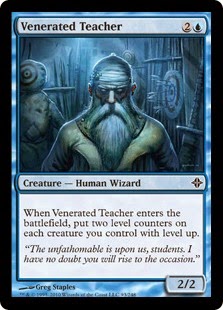
There is a teacher with the right idea.
Lastly, let's talk about "grinding." Anyone who has played WoW or any other MMORPG fully understands the tedium and necessity of grinding. It means standing in a field killing spiders or rabbits for four hours as you watch your experience bar slowly increase, and I don't see why there is no reason it shouldn't be allowed in the classroom. After all, grinding in a classroom setting is basically doing extra math problems or working on some tedious assignment to get a little extra credit. Obviously the "Grind Assignments" would be worth less experience points than regular assignments, but if a student accomplishes enough of them, they will slowly work their way up to the next level. It will also help reinforce the lessons that have already been learned. The essence of grinding is to take on a challenge you know you can easily beat and then repeat that over and over again. Why can't a student grab a basics skills sheet and do that for a small amount of experience points? A teacher can add more advanced skill sheets to the "Grind Pile" with older ones being worth less and less XP as the school year goes on and with newer ones becoming worth more. These would not be assignments, just extra tasks students could accomplish to keep their experience meter moving.

I know there will be many people who might be skeptical of this new idea, just as I realize it will work better for certain classes than others, such as Math and Language. Even though it might be harder to implement in English or Social Studies classes, that does not mean it would be impossible. These are only some of the ideas that are out there. A truly creative and dedicated teacher could easily come up with more, and adapt this idea to their learning environment. The real essence is the experience point system, but you can expand on that anyway you want. What about a loot system, where you get pens and pencils, or even hats and t-shirts. What about a friendly PvP or Arena system? What about a raid system where students collaborate and share XP to take on larger tasks? The possibilities are endless, and best of all, it is a learning system based upon a system we already know works to reach students. It is a system they instinctively understand. So instead of decrying the evils of the gaming industry, maybe its time we took a page from their books to patch some of the bugs in an ailing school system.


March 10, 2015

Back to the Future

Spring is in the air.
I don't even know what the title of this blog means, and I don't care. It's too damn early. Also, if I nod off while typing this I hope you ex... Apples!... What was I saying? Oh, yeah Daylight Savings began this past Sunday, and I, like most Americans, am having a very hard time adjusting. I am exhausted, confused, irritable, and magenta. This all leads me to wonder, "Why the hell do we do this, again?" Seriously, why hasn't anyone put a stop to this? Our government keeps looking for non-partisan issues that are favorable among the American populace. I think we found one. I can't imagine anyone protesting: bankers, students, farmers, Canadians, eggs, meat, dairy, friction, gravity, the letter C... Hornswoggle!...

Sorry. I'm back. Actually, there might be one type of people that in the United States that aren't drastically affected by Daylight Savings Time: Arizonans, but also American Congressmen. I did some checking on the Congressional schedule, and I was shocked (shocked I say) to discover that the House of Representatives is not in session the week after Daylight Savings, because they are lazy, unlike their hardworking counterparts in the Senate. No time change is going to stop a Senator from reporting to duty on Monday, bright and early, at the crack of... 2:00 pm.... I didn't nod off just then. That is actually the time they started sessions on Monday, March 9, 2015. Also, they were so proud of themselves for working half-day on Monday that they gave themselves the rest of the week off. So, I guess we shouldn't look to our Legislative Branch to be making changes to this antiquated law anytime soon. For now, we are all going to have endure the hour of jet lag, (as if the country took a collective red-eye flight from O'Hare to JFK,) but how did this all start, you might be asking? Or not, I could just be hearing voices in my exhausted state.

Actually, the practice started back in Germany during the First World War to conserve coal for the war effort. So like most things in life if you are looking to blame someone, you can blame the Ger... Kaiser Wilhelm!... I was having the weirdest dream. Anyway, the practice was used on and off after the end of the Great War, but it didn't really become adopted by North America until the Second World War, because the Germans had so much fun during the first one they all got together and decided to do it all over again, like that kid who spends all day on the water slide. "Get off the water slide, Jimmy! Other people want to have a turn!"

What? I was somewhere else for a second. Regardless, there are only about 70 countries left in the world that use Daylight Savings, and we are lucky enough to live in one of them, but don't worry we're not alone, as most of Europe, parts of South America, and (the civilized parts) of Australia still use the damn system. So, you may have to wake up an hour early, but it could be worse. You could have to wake up an hour early in France. You'd still be tired, but you'd also be in France, and coffee would cost you twelve dollars and you would only be able to get a baguette for breakfast. So does anyone benefit from this wild idea of time-space witchcraft?

Don't mess with blue countries this week. They might be a little cranky.
Image courtes... Wikipedia!
Daylight Savings used to have a financial benefit. More sunlight meant less time with light bulbs lit and lower electricity bills, but now it just translates into more time running the air conditioner and staying in doors playing Xbox and Playstation and Tiddlywinks, and dinosaur, and pen top, and print toner, and fjgjdyyyyyy... Jim Caviezel!... I hit my head on the keyboard that time... Anyway, as I was saying, there is no longer a discernible financial benefit from the practice, and perhaps the cherry on that cake is that farmers hate it. So for anyone out there who thinks this is for the benefit of agriculture, you can back that Tonka truck up. Those poor bastards have to get up in the morning to feed the chickens whether its dark or light out, and I won't even mention the dangers of sending schoolchildren to school in the newly darkened morning hours, or the fact that car accidents rise 17% the week after Daylight Savings. However, I have found the one group that the time change does benefit, golfers.

Yes, the extra hour of sunlight after the work day benefits golfers, which means the rest of us have to suffer under their white gloved thumb, like a ball being run through that cleaning machine they have on the side of the fairways. You know what I'm talking about. So my real question is, what do golfers do in Arizona, where they do not use Daylight Savings time? (I guess the answer would be sweat, a lot,) Or on any one of the multitude of Native American Reservations where they also don't use the system? Because despite what some people think, this is not a universal law. States, and even some towns, have opted out of Daylight Savings.

Then again, maybe I am being too harsh in my manic sleep deprived state. I mean forget the fact that 63% of Americans don't see the purpose to setting our clocks ahead in the Spring, or that this practice absolutely wreaks havoc with international business, (because when you're in New York its hard enough trying to figure out the time in Beijing without also remembering that you need to add or subtract an hour depending on the season,) and maybe we should all just be a little more like Congress. So I propose, we make the day after Daylight Savings a national holiday where we all start work at 2:00 pm, then go golfing afterward. Wouldn't life be just sw.......................


February 10, 2015

The Avenging Spider-Man

It's official. Spider-Man has been confirmed as being added to the Marvel Cinematic Universe in an unprecedented agreement set between Marvel and Sony. Basically Sony will retain distributive, financial, and creative control, but Marvel will get a piece of the pie. Kevin Feige, the man behind the MCU, is also set to co-produce the next independent Spider-Man movie. This is all exciting news and I think a positive step for both production companies, but it still leaves us with some questions that are worth contemplating.

First and foremost, who will be Spider-Man. Will it be Andrew Garfield, will it be a new actor, will it be me? (Seriously, I'm waiting on that phone call.) Smart money seems to think that it won't be Garfield and that this new agreement marks a new Spider-Man with a new direction. Yet, if that is the case, is the viewing public really ready for a third attempt at Spider-Man? Though, this new Web-Head would have the advantage of being able to hang with Daredevil and get an internship from Tony Stark, it still sets up the question, "Are we are risking Spider-Man whip-lash?" After all, do we want to see another Green Goblin storyline or another Lizard or Electro or Venom... Scratch that I would like to see another attempt made at Venom... But the point remains that the new MCU Spider-Man is not going to be some hit and run hero that gets a five minute cameo in the Avengers and we never see again. He will have at least one more stand-alone movie. So how do we keep him fresh?

The most obvious and exciting prospect is a boy named Miles Morales. For anyone not in the know, Miles is Spider-man in Marvel's Ultimate Universe after Peter Parker dies. Now I'm not suggesting that we kill of Garfield onscreen to be replaced by Donald Glover, (but I'm also not not suggesting that either.) His origins can be changed, but Marvel, Sony, and comics in general have found themselves struggling with ideas of diversity in characters. This is a great opportunity to bring that issue to the forefront. Yes, Black Panther is coming, but T'Challa is an African prince from a distant land. Miles Morales is a kid from a poor neighborhood of New York City. Which one do you think is more representative of the American experience? And choosing the racially diverse Morales over the very white Parker would go a long way to cementing people's faith in Marvel and its properties. Yes, there would be people who would raise an outcry, but Peter Parker has had five movies, two good, one okay, and two bad. Maybe its time to give someone else a turn in the batters box.

Unfortunately, as much as I think this is the direction that Marvel should go, I have doubts it will happen. Peter Parker has too much name recognition. So what do we do with him in his next movie? Most obviously, drop the damn Origin story, especially if it is a new actor. If I had a nickle every time I saw Uncle Ben get shot, I could buy a modestly priced Tesla car. We all know where and when Spider-Man came from. There is no good reason to rehash it again. Also put "With great power come great responsibility" back in to the movie. I know Sam Rami used to to death, but it's a personal pet peeve of mine that it got taken out in the Garfield version... So really I'm just asking that you make me, alone, happy. Is that too much to ask? (Waiting on that call.)

Next, do something new and exciting with the next Spider-Man movie. If its going to be set in the MCU, than really go with it. If we stick with Garfield, I would be interested in seeing a third movie that is about him coping with becoming an Avenger or dealing with whatever just happened in Civil War. Or tell a movie that is half flashbacks to Spider-Man's involvement in the Chitauri Invasion from the first Avengers movie. We know Spider-Man wasn't directly involved in the main battle, but what if he spent the invasion saving people or battling an escaped villain on the peripheral for the invasion. A storyline like that would help cement Spider-Man into the MCU, and may even allow the chance to bring Garfield's already established storyline into the larger universe.

If we don't stick with Garfield, I would still like to see a movie set in the larger universe. So maybe we don't want to use Green Goblin, but what if Norman Osborn does something that tricks the Hulk into rampaging through New York City. Spider-Man would have to stop him, which is an incredibly daunting task for a superhero that is still basically a teenager. It would also allow Marvel to get the Hulk into another movie (something they have wanted to do for years.) This would be a perfect way to put a fresh spin on a Spider-Man movie without dipping into what is left of the lower-level Spider-Man cadre of villains. (If we are forced to sit through a movie version of Shocker or Vulture, I don't know if I could take it.)

Lastly, there also remains the question of how will Spider-Man first appear in the MCU. It has been confirmed that we will get a cameo or a glimpse of him in a Marvel property before we see him in his own stand alone movie. Yet, that could mean almost anything. Does that mean he will be the stinger at the end of Avengers: Age of Ultron? Does it mean he will take the place of Black Panther as a main character in Captain America: Civil War, (which would be a blow for Panther, but in all fairness it was his role to begin with, and it would be a really good way to put him front and center in the MCU,) or will it be in something else or in some other way? I do believe that the manner and way in which he is introduced will set the tone for his involvement (heavy or light) in the MCU, but I suppose only time will tell.

It seems almost surreal this is actually happening, especially considering Joss Whedon was almost crucified by lawyers when he tried to even hide a hint of the Oscorp building in the New York skyline in Avengers. However, this is very good and it is coming at the right time for both companies. Sony is in desperate need. The Amazing Spider-Man 2 was a flop and put them back in the same place they were after Rami's Spider-Man 3. The fact that they are willing to share will put a lot of fan faith back in the studio. 

As for Marvel, they are going stronger than ever, but we can see the horizon and there are some concerns. With contracts for Downey, Evans, Hemsworth, and their other big name stars set to expire the MCU will soon be losing their tent-pole heroes. So how does the Marvel Universe exist after Captain America, Iron Man, and Thor disappear? The answer will be a mixture of carrying on those mantles in other ways. I am almost positive there will be a new Captain America after Evans. Iron Man may hang around as the old man of the universe, but it won't be the same. This is where the potential for Spider-Man is so impressive. He has always been the big Marvel character, but has faded from glory over the past decade as the company has focused more on their own properties and heroes and shined the light away from him, due to the Sony conflict. Yet, in many ways he is still the main-man. He still has the kind of star power that Marvel is going to need to keep them moving beyond that Infinity War threshold. Introducing him now could represent the passing of the torch from the Big 3 back to our friendly neighborhood Spider-Man and the continuation of this shared universe they have created.


January 28, 2015

Whether Weathermen Were Wrong...

There are few certain things in this world: the inevitability of bad hair days, the slow unrelenting march of age and time, and the death of a Sean Bean character. Yet, there is much more that is uncertain: stock prices, the number of socks that will emerge from the dryer, and, of course, the weather. Let's spend a few minutes dwelling on that last one, because despite the insistence of a certain doomed Sean Bean character, winter doesn't always come. That was proven on Tuesday when the New York area found itself bracing for a massive hurricane of icy death that never quite panned out.

Sure, we got a few inches, but growing up in the Northeast those are the kind of numbers you find yourself laughing at as your car skids slowly to work in the morning. What we were promised was a winter storm so impressive that it would bury us under feet and feet of snow. Curfews were enacted across New York and New Jersey. Trains, buses, and subways were shutdown. States of Emergencies were called. Government offices were closed, and grocery stores couldn't have been ransacked harder if there was a horde of ice zombies coming. I, personally, got up at 5:30 am to race the storm home from Maryland... Then it started snowing... Then it stopped and everyone emerged from their cocoons of blankets and Netflix to see that nothing had happened... Then a lot of people got mad.

Did you know that the 1977 revision of the Geneva Convention prohibits the weaponizing of weather? I know, it sounds like a plot cooked up by Cobra Commander, but did you also know that the United States of America successfully used weaponized weather during the Vietnam War? Operation Popeye used cloud seeding over Vietnam to increase the rainy season by thirty percent, in order to hinder troop and vehicle movements. Yet, seeding clouds is not the only way to use the weather as a weapon, and I have been hearing many people over the past few days call the false reporting of meteorologists, nothing short of criminal.

FYI, this is also against the Geneva Convention.
"Those weather-hacks misled us! The lied to us! We all put our trust in them and this time they used their power as a weapon to shutdown one of the world's largest and most densely populated metropolitan areas. New York City, New Jersey, and Philadelphia all came to a grinding halt because of the false promises of meteorologists and their scary, albeit colorful, maps of doom. They didn't even apologize, (except for the ones that did!) They told us falsehoods! They mildly inconvenienced us and damn them, they gave me a day off of work! Meteorologists may not be able to manipulate the weather, but they manipulate our feelings about the weather, and maybe its time we held them accountable.

"Under the Geneva Convention we should prosecute them as war criminals! Let's put them on trial in front of an international court. Let's send a message that we will not let our lives be dictated by people with names like Gretchen Storm and Sonny Day. I promise, no longer will the sadistic cackle of the dreaded Weatherman echo through the frozen halls of his Arctic Doppler Fortress. Huzzah! After all, what have they ever really done for us?"

...I mean aside from saving lives and preventing property damage. According to a 2013 World Bank Report, a fully staffed and equipped meteorological service saves an average of 23,000 lives a year and provides up to $30 billion a year in economic benefits. The real truth of this issue is that I think it is easy to hate on weathermen. Their jobs are based on speculation, and, in fairness, they are not right all the time. In fact, if you are looking for an interesting piece on the accuracy of weather forecasting I suggest you check out the Freakonomics site, which basically maps out the accuracy of weathermen in Kansas City over their seven day forecast. Spoiler: They are not 100% accurate, but that doesn't make what they do is any less difficult or valuable.

Granted, that even after the storm proved to be bust many stations kept their reporting up, as if we really were under attack by the love child of Elsa and Mr. Freeze, but that has more to do with the news stations than the actual meteorologists. If Fox News has taught us anything it is that scaring people is a surefire way to get good ratings, and maybe there were a few people out there who were more willing to fudge the numbers in one direction if it meant people would watch, but that was not the majority. If anyone is to blame, we are. Because, when you really think about it, meteorologists are a lot like the weather they report. We really don't pay attention to them till we need to, and even then its usually only in a negative way, Maybe that's part of the reason why sometimes they get a little overly excited about bad weather, in the same way firefighters get a little too excited about a structure fire. Only in catastrophe do they really get their chance to shine.

"I'm wearing camouflage, because... Did you see what
happened to that last dog?"
Unfortunately, this time their excitement led to the loss of hundreds of thousands of dollars by state and local businesses who listened to the dire warnings of weathermen and weather-women as they gazed into their crystal balls, but I don't mean to sound flippant (that just usually happens naturally).  I have a lot of respect for the people entrusted to predict the movements of nature. Weather forecasting is a science, but it is not an exact one. There are still many mysteries on why weather behaves the way it does, and what we get as a forecast is usually the best possible data as interpreted by local and national meteorologists. That means they are using their models and scientific understanding of weather behavior to give us their best estimate as to where a storm system will be heading and what conditions will lead to one forming in the first place. It also doesn't help that the American National Weather Service is woefully underfunded and understaffed.

In the past five years the NOAA (National Oceanic and Atmospheric Administration) budget has stayed relatively flat, despite significant budgetary increases for other federal departments. Even worse the National Weather Service has suffered from some 200-odd labor shortages, finding themselves without the money to hire and retain key meteorologists, even in critical areas such as Tornado Alley where accurate weather predictions help to save thousands of lives annually. This is trouble for local weathermen who get their core data from the National Weather Service, which helps them make their predictions. This severe underfunding is also one of the main reasons why the European weather agency, (European Centre for Medium Range Weather Forecasting) typically produces more accurate weather models than the US National Weather Service. They have better equipment with faster computing power

All of this leads back to the super storm of snow that was supposed to hit New York this past week. Many weather agencies went with the European model for the storm, due to its track record of better accuracy, and for whatever reason, this time the European model was wrong and the American model, (which predicted that the storm would miss the city,) was actually correct. That's how bad it has gotten for the US National Weather Service. Even when they're right, the local agencies don't believe them. It's like their the weathermen of weathermen.

On the plus side, the development of hover technology is
coming along in time for Marty McFly's arrival this year.
The United States needs an updated weather model, proper funding, modern equipment, and proper staffing. Maybe if the weather could be used as a weapon of war there would be more funding available, but right now it is a low priority on the national budget. Yet, it shouldn't be. The National Weather Service does more than tell us whether to take an umbrella or sunscreen. Poor and improper weather forecasts, whether negative or positive, affects millions of American and billions of dollars worth of industry and infrastructure. Everything from mass transit to national trucking industries are affected by the weather. 

So yes, this time the weathermen got it wrong, but that doesn't mean they are always wrong or that they are criminals. Human beings have a tendency to want to kill the messenger, but the general public needs to reevaluate how we think about the weather and those who report it. With changing climates, global warming, and a myriad of other factors, the job of meteorologists gets harder and more important every year. That's why they need our support. So maybe with a bit of work, a bit more money, and a little faith, next time it will be different, (yes, there will be a next time,) because the weather can be a weapon, but not one controlled by humans. Still, it is no less dangerous. Weathermen and weather-women are the ones trying to keep us safe and prepare us for what is to come, because if we aren't prepared then that would be the real crime.


December 22, 2014

Please Don't Hack Me, Supreme Leader

I don't get why Kim Jong-Un finds these two morons so
threatening. I mean did he even see "This is the End?"
Sony Pictures has decided to cancel the release of The Interview with Seth Rogen and James Franco. This is the kind of thing I never thought would happen, (and obviously Rogen thought so as well considering it was only last Monday night that he was on Colbert plugging the movie.) There is something unsettling about this whole affair to me. Sony Pictures caved into terrorist demands almost immediately, basically capitulating to censorship sponsored by an enemy nation. There is going to be a lot of repercussions for this and I don't think they even realize it. Yet, I should give you a little background.

The Interview is Rogen's newest attempt at being funny. The plot centers around two journalists tasked by the CIA to kill Kim-Jong Un. When the movie was announced, North Korea did some cartoon-villain-like sabre rattling (because that's the only way they can really do anything.) No one paid it much mind, and the American government (rightly) said they would not step in and hinder the free speech of a private company. Fast forward to last week when Sony came under attack by hackers, with suspicions of North Korea being behind the attack. Then additional threats were made against theaters who had planned on showing the movie on its Christmas Day release date. After major theaters like AMC and Regal announced that they would not opt to show the movie in their theaters. Sony countered by announcing they would not release the movie at all, not in theaters, not on DVD, not on Netflix... not anywhere. Because why should the US government have to step in to censor artistic expression when corporations can do it for themselves.

Now before anyone gets all righteous about protecting innocents from terrorist attacks, there is one thing you should know. The hackers known as the GOP (not that GOP. That GOP has it's own unique way of hindering our country's progress.) The Guardians of Peace made violent threats against any theater that would screen The Interview on opening day (Christmas, which is one of the biggest opening movie days in the United States.) Those movie theaters that opted not open the Rogen film did not do so out of compassion and concern. After all, the premier of the movie was the GOP's main target and that had already happened in L.A. without so much as an anti-climatic fistfight between Franco and Toby McGuire. The rationale behind the theaters' decision was purely financial. They worried that the threats would keep people from going to the theaters on their most lucrative day of the year. (For theaters that day is like a special day... almost like a holiday where they receive lots of things they want... I can't think of a good metaphor... Let's call it their St. Patrick's Day.) So AMC, Regal, and all the rest made a decision to not take the risk and denied screening The Interview. In response, Sony decided to cancel the release entirely instead of risking taking a bigger hit on the movie's returns than they had to. You see, if Sony cancels a movie, completely, under these circumstance they can recoup some of their loses through insurance, but if they risk doing a release and the movie bombs they also risk making back even less of their profits. Sony opted for the safe choice, and canceled to collect on the insurance, but what does that mean for the rest of us and the entertainment industry as a whole?

Kim Jong-Un could only wish he would ever be this cool.
Well... before we jump into the long lasting implications, let's get one thing straight. This was a cyber attack made by a foreign country. The FBI confirmed that the hack came from North Korean agents, which honestly wasn't that hard to figure out. I mean just look at the attackers released statements: "We will clearly show it to you at the very time and places The Interview be shown, including the premiere, how bitter fate those who seek fun in terror should be doomed to... We recommend you to keep yourself distant from the places at that time. (If your house is nearby, you’d better leave.)" I mean c'mon. Those statements were either made by North Koreans who only have the most basic grasp of English or they're the lyrics to Kayne West's next single. If you're going to make threats to America the least you can do is run them through one of those translators you captured. Even ISIS has that much courtesy. (Also what kind of jackass uses parenthetical statements when trying to make a point?)

Truthfully, I am just kind of impressed that there are agents in North Korea that know how to work an AOL account, (or DKRPOL account?) because from all reports, North Korea doesn't even have the Internet. Thus if there are a few trusted agents in North Korea that are allowed to access the world wide web, I'm just surprised... Not so much that they have the skills to accomplish their goal, but that they found the time between all the porn and kitten videos they must been splurging on. I mean can you imagine growing up in a country that has never had the Internet and then suddenly being allowed to play around in a world where you can find a video of a dramatic chipmunk. Hell, even while inserting that last link I had to watch that clip six times before I could get back to being productive, and I've seen it literally hundreds of times before. I'm surprised these North Korean hackers didn't go into some kind of future-shock-like masturbation comma from all the wonders they probably experienced for the first time while trying to stay focused on hacking Sony. Heck, I wouldn't have been shocked if you told me that those agents hacked Sony, started watching the Amazing Spider-Man 2, immediately started a judgey Internet blog so they could criticize how bad it was, and then just hacked Sony out of pure frustration. #TobyMcGuireIsMyDearLeader

And if you enjoyed that last paragraph, than you have a sense of humor. If you didn't enjoy it, than you probably have a better sense of humor than me, but that's not the point. The point is that in North Korea I would be shot for making those statements. My entire family down to three generations would be forced into labor camps or outright killed because of what I just said. Humor is what separates us from our enemies. The fact that we can not only laugh in the face of our enemies, (and ourselves) but have the institutional and personal freedoms to actively do so is incredibly precious. Stop and think about it for a moment. Not only do we NOT live in a country where people like Jon Stewart are dragged out into the street and shot by secret police, but we live in a country where Jon Stewart and Stephen Colbert are celebrated for their humor. We used to even live in a world where a major motion picture company was willing to shell out hundreds of millions dollars to Rogen and Franco to make a movie about making fun of a brutal dictator. Now we live in a world where that same corporation will impose its censorship out of fear and threats to their bottom-line.

"I know who to bwame...Bwing me the hwead of
Judd Apatowww'"
So what does this mean for the entertainment industry and the larger world as a whole? Well it means that people are going to start tip-toeing around their content. Already a planned Steve Carell movie has been canceled because the setting is North Korea. Maybe Comedy Central will start to worry about repercussions and hackers and start censoring Colbert (RIP,) Stewart, and South Park (this seems unlikely, but there is now a precedent.) As a writer who has insulted North Korea on (several) occasions, and who is currently working on a novel that portrays more than a few countries in a less than glowing light, I worry what this may mean for me. Will I have to start self censoring myself because I insulted Dr. Crazypants Kim Jong-Unhinged? What if I say something bad about Putin or the Chinese government? Will my book get published? Will my publishers get spooked or get hacked? Will they cancel that sweet sweet book tour I have been waiting for my entire life? (First stop Pyongyang Barnes and Nobles.)

The irony is that I'm not even a fan or Rogen and Franco. I was never big on drug humor and dick jokes, which seems to be their specialty. I wasn't even planning on seeing this movie, but now I feel as if it is my obligation to see it. In fact it was Mitt Romney, the humorless android who one day hope to be a real boy, that actually made the best suggest. Let's stream this movie online for free, and give people the option to donate $5.00 to combat the Ebola epidemic. Not only then would we be giving a huge middle finger to our enemies but we would be raising money for a good cause as well. Regardless, this has become an important movie, not despite its humor, but because of its humor.

The ability to laugh is extremely important to our society. It's not just about frivolity or getting a chuckle once in a while. It helps us to not take ourselves or the world too seriously. Lewis Black has a great rant about this subject where he says, "Patriotism and religion are only in balance when they have a sense of humor. When they don't, things go awry." When countries and people begin to lose their ability for silliness and parody you get extremism, much like in North Korea. I can't help but draw parallels between what is going on now and Charlie Chaplin's The Great Dictator, where he lampooned Adolf Hitler at the height of his power. That movie was not only released but was nominated for five Oscars. Let's be honest Hitler was a lot more of a legitimate threat that Kim ever was, except Kim has proven a threat to Sony's quarterly reports and now it is the rest of us that are going to pay the price. Yet, the problem with extortion and terroristic threats is that they don't end. You give into one and (like feeding stray cats who are strapped with vests of C4) they keep coming back expecting more. This short-sighted and cowardly move could very well be the first step down a very slippery and very unfunny slope.


October 29, 2014

GamerGate: Rated I for Immature

I don't want to talk about this. I fucking don't. I want to spend my time dissecting the Avengers 2 trailer, or talking about how mistaken I was about Gotham, or pondering over the DC/Marvel movie announcements, but I can't do any of that. (I mean I can, but the truth is there is a shitty elephant in the room that can't be ignored.) So I won't talk about any of the fun stuff, the stuff most of us really just want to obsess over. Instead, because there are a few dickheads out there, we have to talk about GamerGate. I was hoping this would go away, like that sharp pain I have in the back of my mouth. I was hoping if I ignored it long enough it would pass and we could all go on with our lives, but also like that sharp pain in the back of my mouth it seems as if the whole thing has become worse. Now we all have a compacted molar that requires some kind of drastic and terrible surgery.

I would ask if the douche-bags out there harassing women on video games realize that it is almost 2015 and not 1015, but that would be a stupid question, because gaming back in the 11th century required a greased pig and someone stupid enough to try and wrestle it. As opposed to nowadays when it seems that all is required is a gaming device and someone stupid enough to think that harassing women should be acceptable in any goddamn situation. I have talked before about the harassment women have faced in the nerd community, but that was a well-reasoned and sensible argument. My mistake was thinking that a level-headed plea for congeniality would ever reach the kind of bastards that perpetrate this pigheaded crap, especially in the gaming communities.

So sit back and open wide jerk-off's because I am going to frag your ass then teabag your open gullets till you learn to shut your fucking mouths.

For the record, I know its not all gamers. In fact, I believe the vast majority of gamers are good and decent people who want to do the right thing, but the culture of gaming is being driven by outdated assumptions and a few assholes who have a very special place in hell reserved for them, the level reserved for serial murders and people who chew with their mouths open. It's these jerk-offs who are driving this shitstorm of embarrassment and harassment.

For anyone who is still not sure what GamerGate is, it all started during the summer when a female game designer, (whose name I will not say, because the poor woman has taken enough crap and I don't want to add to it,) was publicly accused by an ex-boyfriend of having a romantic relationship with a journalist from the gaming/nerdy review site, Kotatku. This led to a campaign of moronic fuckheads bombarding her with so many disrespectful comments and threats that she had to flee her home. Supporters of GamerGate will tell you that the controversy is about journalistic integrity in video games, but that's utter bullshit.

Then again maybe gamer journalism may
also be part of a larger problem...
If there is corruption in video game journalism, it's not because of some Indie game designer and her woman parts. If this was really about integrity you would be directing your hateful comments at the large magazines and video game companies. Do you know how much it makes to produce a Grand Theft Auto, a Destiny, or an Assassin's Creed? Millions and millions of dollars. It is a larger time and income investment than creating a movie. So studios, of course, want to make sure they make their money back. That means they need to create hype, which means sending advanced (read: free) copies of their games and equipment to reviewers and magazines (I would assume along with a generous gift basket.) If I'm a reviewer and I am getting free games from Sony or EA, maybe I might start considering that if I keep slamming their products I may one day stop getting free brand-new games, which the rest of us have to shell out sixty or seventy bucks for. So maybe I would start easing off on the criticism, giving an extra star here and there, and basically ensure that my free video game train keeps pulling into my goddamn motherfucking station.

So maybe all you assholes out there should start threatening the lives the people over at Gamer Magazine or Nintendo. Maybe you should start hacking them and releasing their personal information onto the web. Oh, wait... You won't, because you're cowards, and because this has never really been about journalistic integrity. It's because there is a small group of cheeseheads (Fuck you, I'm not really good at cursing,) in our gaming culture that thinks its alright to harass women even though 48% of gamers are women. That means 48% of people out there are too afraid to talk in voice chat or reveal in anyway they are women. God forbid you let the other people on Call of Duty know you're of the opposite gender, because prepare to spend the rest of the match hearing nothing but catcalls, sexual remarks, sexual threats, and probably a few instances of the words "whore," "slut," "bitch," or maybe even a colorful remix of all three put together (like a kaleidoscope of hatred.) Who the hell would want to deal with that?

Even worse, the culture of gaming says this is okay. Video games themselves portray women as objects to be rescued or eye-candy to be ogled. Maybe that's why when women try to speak out about their delegated roles in both videos games and in the gaming culture they find themselves immediately shamed and threatened in the worst possible way for doing so. Recently, Felicia Day, spoke out about GamerGate, and within an hour (60 fucking minutes) hackers released her home address. Video game critic, Anita Sarkeesian, had an entire college campus threatened with a school shooting if they allowed her to speak. Even Robin Williams' daughter, Zelda Williams, had a bunch of fucking asshats send her graphic Photoshopped pictures of her father's dead body (May he rest in peace) right after his death. She had to shut down her twitter account because of the harassment.

When women speak up for themselves an element of gamers start to feel threatened, yet when male gamers speak out against GamerGate like Dan Golding or BuzzFeeds' Joe Bernstein they receive almost no blow-back, and certainly not on a level with the kind of death threats and hacking scandals that get targeted at women. It's because the shitbag cowards out there that perpetrate this crap don't care so much about defending their point as shaming women. I am not going to go into the more complex psychological underpinnings of that kind of attitude, whether it stems from early social awkwardness, early damage caused by an overbearing female figure, or just having too small of a dick, I can't say. I'm not a psychiatrist.

Life can be dark and unfair, to balance that: here is a
picture of a puppy and kitten napping together.
Regardless, if there is one thing I can't stand it is people that get their perverse kicks from making others feel worse about themselves. So I'm done being rational. The fuckholes out there who do this to women are the worst kind of people. They are driven by their own fears and insecurities, and they spit hatred for the same reason that when you were in kindergarten you pulled that girl's hair, because you were too socially undeveloped and awkward to fully articulate or realize your own short-comings. In a six-year old it's cute. In an online gamer its sad and dangerous. In fact it is that unawareness and those fears that drive these morons to do everything they do. It's easy to make threats and be a douche-bag when you're sitting safely behind the anonymity of an unoriginal reddit handle. It's easy to catcall and slut-shame when you are nothing but a digital voice standing behind a pixelated gun-barrel. It's easy to be afraid when you realize that a culture and something you have built your identity on is not really what you thought it was. (You may not be well liked by women, you may have a small dick, but at least you can win at Halo... oh wait a woman beat you... Your world must be crashing down around you)... too fucking bad. 

Do you realize that with 48% of gamers being women, if all women stopped gaming that very expensive gaming industry, which I was talking about earlier, would completely collapse. Maybe it is easy to forget that the people on the other end of the Internet are actual human beings with hopes and fears and loves and dreams. Maybe that is the dangerous by-product of an industry and a culture that for so long has seen women as nothing more than a pair of boobs in an impractical suit of armor, or a blog of pink pixels which you need to rescue by defeating a lizard monster. Then again, maybe some people are just assholes for no other reason than that they are. For whatever reason I am sick to fucking death of this kind of vitriol and sadistic treatment of women. 

So suck it up, accept it, because eventually every kindergartener need to grow up and learn to play in the sandbox nicely with the girls. (I promise they won't give you fucking cooties.) Just because you play games set in the dark ages doesn't mean it's okay to act like it.


I would say being a woman gamer is a lot like this...
but really it just seems that being a woman in general is "a lot like this.".

September 25, 2014

Ghostbusters III

I know it has been a while since my last blog post. To any of my loyal readers (hi, Mom,) I apologize for the long hiatus. Life has gotten pretty crazy over the last four weeks, but all that is in the past. Now we look to the future, and depending on what news source you look to, the future may or may not involve a third iteration of the Ghostbusters franchise (or a prequel, or a reboot, or an all girls cast, or movie set in prehistoric New York.) I don't want to address any of the rumors out there or even comment on them. I want to just float my own ides for what would make a worthy successor to two of my favorite 80's movies.

First off, let's lay something out, right off the bat. There are very few flaws in the original Ghostbusters and Ghostbusters II. The tone is consistent, the movies are fun (with the right mix of believable suspended belief and over-the-top-Staypuff-Marshmellow-Man moments,) and they are funny. So it unnerves me sometimes when I read a lot of these supposed ideas for a new movie and I find people who just want to mess with (in my opinion) what works. So for the movie I am proposing we want to keep it as close to the originals as we possibly can, with the same feel.

However, we also have to be careful. Since we are introducing a new cast we also don't want our four new Ghostbusters to be bad carbon copies of the four originals. Now, I don't care if they are all women, or all men, or all kittens (I just got an idea for a viral video.) If a character works it should work regardless of gender or race. (Those things can be fleshed out in casting.) What I am concerned with, is that we don't have four people who are trying too hard to be Dan Akroyd, Harold Remis, Ernie Hudson, and Bill Murray (no one can be Bill Murray, but Bill Murray). That would be a mistake as those four individuals are unique and I don't want to watch a movie about four people I don't care about trying to be people I really do care about. All that formula does is make me want to walk out of a theater and pop in a DVD of a far better movie. Instead, we need new characters that work in the vein of the original Ghostbusters but bring their own spin to their roles. In this way the audience can fall in love with them for different reasons. After all, when you break up with a person, do you immediately go out and try to find their exact clone? No, every person is unique and the love you have for someone will always be different than the love you have for someone else.

Yet, one of the things we need to keep is the working-class feel of the old movies. Part of the appeal of the Ghostbusters is not that they were superheroes (and I will say this now, with the capslock down: MAKING A NEW GHOSTBUSTERS MOVIE FOLLOW IN THE GENRE OF BLOCKBUSTER SUPERHERO MOVIES WILL RUIN THE FRANCHISE.) With that said if during the movie, once the new Ghostbusters' business gets off the ground, if they wanted to make a really bad commercial portraying themselves as superheroes, which also lampoons those typical blockbuster movies, that would be comedy and completely appropriate. However, that cannot be the movie. Ghostbusters at its heart is about working stiffs trying to do a job that makes them more like exterminators than crime fighters, but in the end they manage to save the city of New York, despite the fact that they seem like the last people who could accomplish it.

Now that we have some of the ground rules established let's talk plot. I have a few ideas which I think would work and help make this new movie unique yet still fun and franchise friendly:

Buy the shirt at Cracked.com
We should open up with our main character, a thirty something year old who is down on his luck. Fired from his job, no girlfriend, broke as hell... the works. He decides to go back to college to try and improve his situation. (This should all be explained quickly and without a lot of fluff.) He is paired with the roommate that no one else wants. He is a college age student that is kind of weird, a little out of touch with the real world, but very intelligent. Our main character will make a quick connection with another student. This one is kind of a troublemaker, but very intelligent. Perhaps our hero can save him or her from some situation (such as getting suspended.) They would meet because they have a class together. This new character might have to be the opposite sex from the main character as to spark a romantic interest to give further motivation for helping them out. The troublemaker character would not be grateful though and would walk away.

Establishing the characters needs to happen very quick. We don't need an origin story. We just need a flavor for each of the four new Ghostbusters and let the audiences imagination fill in the rest. Also any romantic tension between opposite sex characters needs to never (I repeat never) come to fruition. This is not a romantic comedy. Play the tension for laughs, but do not let two Ghostbusters get together. (Look at how Guardians of the Galaxy did the romantic tension between Starlord and Gamora for an example.) If you must let them get together, (because this is Hollywood) than suggest it at the very end of the movie (similar to how the Peter Venkman and Dana Barret relationship plays out,) but never confirm it.

The fourth Ghostbuster should be a random student thrown into the mix. Our main character and his roommate will have the same Physics class taught by Professor Ray Stanz (Dan Akroyd cameo.) They will be put into lab groups, with the two roommates obviously working together out of necessity of not knowing anyone else. The main character would rope in the troublemaker (perhaps due to his/her sexual interest in them,) and the fourth member would be just a new face. He/she could maybe be a little dumber (but not Hollywood idiot dumb,) but maybe they are a smooth talker, a snake oil salesman. It would be during a late night research session in the library that the four characters come across their first spiritual encounter. The library would be a good and appropriate place for this to happen. This would spark the interest of one of the group, possibly the main character, which would lead them into research about paranormal activity in New York. Now we get see them come across research of old Ghostbusters' footage and newspaper clippings. This leads the group to the realization that their professor was once a Ghostbuster. 

Still better graphics than the CGI on The Mummy Returns.
Fast forward to them talking with Ray who is reluctant to talk about the Ghostbusting days, but does so anyway. This gives our heroes the idea to bring back the Ghostbusters as a way to make money to pay off their student loans and debts. Ray is reluctant, but eventually shows them the original proton packs, but refuses to let them use them. (You know because they are unlicensed nuclear accelerators and all...)  Our four new heroes eventually steal them and use them to trap the library ghost, which convinces Ray that maybe it is time for the return of the Ghostbusters. Montage scene of establishing the business (creating a Facebook page, a Twitter account, and buying a rundown building with the last of the main character's life savings) and the Ghostbusters are back in business.

I am undecided if the new Ghostbusters should return to the firehouse. Realistically that property would be waaay out of their price range in modern New York City, especially considering its prime location in the downtown area. In fact, the movie can even make a joke about how expensive it is, and even give the building a cameo, but not settle on it. Another possibility (and this is unlikely) is a cameo by Bill Murray who still owns the Firehouse and has tried to use it to make money over the years (turning it into a night club or a Ghostbusters museum,) and is willing to let the new Ghostbusters use it for a price. Also I want the next cameo by Ernie Hudson to be as Winston, who now owns a car dealership or automotive repair garage. (The irony being that he is the most successful of the original crew.) He has kept Ecto-1 preserved in his lot. The new Ghostbusters will use it and restore it.

This should all happen very quickly. The Ghostbusters need to be in business by the half-hour mark of the movie. The remaining seventy minutes of the movie need to be devoted to pure ghostbusting and the eventual big bad Zuul/Gozer demon-spirit that is steadily rising to power throughout the movie. The Ghostbusters will eventually have to stop it and just like in the original movies the movie should end with some big ridiculous thing happening (the rise of Staypuff Marshmallow Man, or the Statue of Liberty walking through NYC.) Basically, the formula for the movies is sound and its been thirty years since we have seen a new movie, (so there is a very low risk of a formulaic plot being seen as stale.) I don't think there is a big need to change up much else. Even the classic CGI look of the ghosts feels pretty good even three decades later. This is definitely the case where too much tinkering would be a bad thing, and besides maybe updating the jokes and establishing the cast as their own characters I don't see much need to mess with a winning format.

On that note, let's just touch on casting real quick. First off, I don't want our new cast to be big name celebrities or comedians. I don't want to see a Melissa McCarthy, or James Franco, or Michael Cera, or anyone who has been in Brides Maids, The Hangover, etc... stepping into these roles. Remember that even though in the early 80's Bill Murry was a rising star, this was not a Bill Murry movie. So the last thing I want to see is Ghostbusters III becoming a Seth Rogen movie.

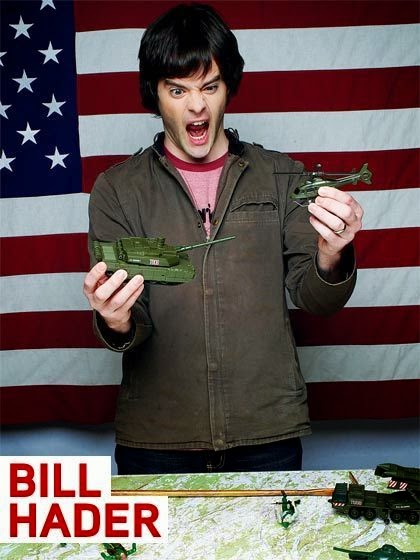
I can see this working
However, having some minor star power would not be amiss. For one thing, I see our main character as being played by Bill Hader. He has the right amount of funny and recognizableness without overpowering the movie. Also he has the Saturday Night Live connection which harkens back to Akroyd and Murray. With that said though I don't want to see an all SNL cast, nor do I want an all male/white cast. This is modern 2014 New York, the most racially complex city on the planet. The Ghostbusters should be similarly multi-racial, (and not with just one token black guy who gets way less screen time, either.) Additionally, I would not be remiss if we found out one of the new Ghostbusters was gay/lesbian. As the Ghostbusters of old reflected the sensibilities of the their time, so must the new Ghostbusters reflect the sensibilities of today.

Most of all, though, we have to remember that this movie is supposed to be fun. Obviously, I have no real control over if/when/how/what this movie will be (nor do I believe that anyone who would be penning this script will ever stumble across my blog,) but I do hope they keep at least that one tenant above all else true. This is a fun comedic movie. It is not a summer blockbuster, nor is it a place where we should try and cram as much advertising and revenue into it as possible (al la Man of Steel,) though I doubt Hollywood will be able to resist that one. Ghostbusters at its core was always about giving the audience an hour and a half break from their lives to laugh and enjoy the antics of four of the unlikeliest heroes, and that is something that cannot be missing from whatever the next Ghostbusters project is... At least that's my advice. 


August 26, 2014

An Icy Challenge

Cap took the challenge to a bit of an extreme.
Last week, I was challenged by my dear friend Shawn to the ALS Ice Bucket Challenge, the craze that has been sweeping the Intra-Webs for a solid six weeks. For any of my readers not living on planet Earth, the Ice Bucket Challenge is where you video record yourself dumping a bucket of ice and water over your own head. You then nominate friends and family to do the same. They have 24 hours, or they have to donate to the ALS Foundation, (For anyone curious enough to ask, I donated,) which in my opinion is the curious part of this whole damned thing. I don't quite understand why anyone would dump freezing water over their heads to get out of donating to a worthy cause.

Now I don't want to come off as a "hater," (That's a technical term here.) I can't discount the good that the Ice Bucket Challenge has done to raise awareness of Amyotrophic Lateral Sclerosis, or all the money it has raised. In fact between July 19th and August 18th, the foundation has reported receiving $15.6 million. That's no small sum of money for an organization that usually only nets a few million in a year. Yet throughout this whole thing  have found myself feeling conflicted.

For as much good as this Internet craze has accomplished, I find myself questioning a society where it seems that the only time we can accomplish anything worthwhile is through the use of an elaborate selfie. Why is it that we need to advertise our good deeds on Facebook, Twitter, (or on a blog.) The Internet and social media is a powerful tool, but it isn't the only tool we have at our disposals, nor does it give us license to celebrate our good deeds for the world to see. If the only reason you accomplish something good is so that it can be "retweeted" or "shared" than it's probably time to wonder if you are performing a good deed at all, or are you just looking for digital accolades.

Perhaps that sounds harsh, and I can see why it might, but I have always believed that the greatest deeds were the ones performed in the dark. You do something because it is the right thing to do, not because you are looking for recognition or a reward. Yet, in today's social media culture such quiet moments of solitary heroics are becoming rarer and rarer. When everything from your lunch to your workout schedule is being posted, perhaps it is unreasonable for me to assume that people would not post updates about how they helped that old woman across the street or gave a sandwich to that homeless man on the corner. Then we can all give it a thumbs up, and tell that person "Ur G8T," or "Way 2 Go," or "Ur the the most selfless person I know."

Accept the praise and the cheers when you deserve it, when you have accomplished something truly remarkable, but not for the good deeds you do. Those, by definition, should be unremarkable. We should all want to live in a world where donating money, helping a worthy cause, volunteering, etc, goes wholly unnoticed, because of how commonplace they are. The Ice Bucket Challenge is not as bad as all that. It is fun, and it lets the more creative among us really show off our flare and individuality. Maybe the ends do justify the means on this one, but, in my opinion, in a world where so much of what we do is constantly being recorded, labeled, tagged, and uploaded, it makes those quiet moments of small heroics all the more important.

It's chilly when you step down off that soap box.

May 28, 2014

The Information One-Lane Highway

What makes a good network go neutral?
Whether you have been aware of it or not there has been a lot of talk lately about net neutrality. Its a term that's getting thrown around more than pies at a clown convention, but what does it really mean? The long and short of it, is that Net Neutrality refers to the idea that the flow of information on the internet should be treated fairly and equally. It means that no company has the right to restrict or slow down your access to certain sites, or prioritize certain internet services over others. After all, we pay for our Internet bill, therefore we should be allowed to decide what and when we see something... At least that's the way it is supposed to work in theory. (For more FAQs, check out the Save the Internet site.)

And that is how most people think the Internet works. You pay your bill and then you can go on whatever website you want, and (if you live alone like me) you assume that since you are the only one using the Internet and you have the browser clicked over to Amazon.com that all your bandwidth power is being directed to that one site. (After all, why wouldn't it?) But that's not how it works. Internet service providers (ISPs) like Comcast and Verizon have been artificiality slowing down certain sites, most notably Netflix, to homes. They are basically trying to extort money from large Internet companies (like Amazon, YouTube, Hulu, and Netflix). If the company doesn't pay them they will slow their access down to a crawl, which means that when you're streaming Die Hard 5 (or a good movie) on your Netflix you will keep losing video quality and may even have to wait as parts of the movie buffer. (You know like the porn videos you used to watch back in 1999.) Worst of all, who does the customer blame? Not Comcast. No they blame Netflix, even though its not their fault.

Netflix has already paid Comcast their blood money to ensure that their service will not have their speeds restricted. The article I linked tries to spin the agreement like its a good thing, but the truth is that Netflix paid Comcast for the right to not be restricted. They didn't pay for priority access. They didn't pay for their service to be faster than others. They only paid so as to not be restricted. That would be like me paying extra for food, not because it was better or served faster than other food, but just to ensure that the cook doesn't decide to drop cyanide in it... And do not mistake my meaning. this type of behavior is cyanide to the freedom of the Internet.

"Would you like that with or without rat poison?
The 'without' option is only an additional $2.99."
This is made even worse because large ISPs like Comcast and Verizon basically form an oligopoly. It's like a monopoly except there is no singular man with a top hat and monocle. Instead, it would be like if the battleship and race car decided to split the board in half equally and charge the same prices to everyone to use their services. They are no longer competing, because once a year they would get together and decide to raise their prices or change their services equally, and what can most homes (or hotels) do about it? Comcast and Verizon own and lay the fiberoptic cables that carry the Internet. Most places in the country literally don't have a choice in who their Internet service provider is. It's similar to the electric and gas companies (as most homes don't have a choice which utility company they can use,) except that those services are regulated by the government. ISP's are 100% private, and now they are pushing for even more freedom. (Freedom to them but what could amount ot tyranny for the Internet.)

Up to this point companies like Comcast and Verizon have been classified by the Federal Communications Commission as Common Carriers. Its a legal definition that applies mostly to phone companies, (which Verizon and Comcast also are,) and both companies as well as lesser known ISPs have basically been happy to be classified as such for the past few decades. After all, being a common carrier comes with certain protections, but it also comes with certain restrictions, most notably the rule that common carriers cannot prioritize one communication over another. (So a phone company can't charge an automated calling company more to prioritize their phone calls over your Aunt Phyllis' phone call.) In January a federal court of appeals struck down the idea that ISPs were common carriers because they claimed they were carrying information and not communication.

This ruling has now opened up a new fear in many people. ISPs could start charging content providers or even customers directly for services that were otherwise free. "You want access to YouTube? That will be $4.99 additional. Do you want access to Facebook or Twitter? Get the social media package for an additional $8.99 a month. It will appear automatically on your bill." Regardless whether ISPs charge the customer directly or the content providers the cost will eventually get passed along to the consumer. That means higher costs, longer download times, and if it gets bad enough you will start to see a lot of the Internet's more innovative and free sites (Like YouTube and Wikipedia) fall by the wayside. It would also hinder growth, because what would be the point of growing your website if you risked getting so big that ISPs decided to slap you with an additional fee just so people could continue viewing it? (At least that is something I will never have to worry about.)

This kind of thinking runs parallel to everything the Internet has accomplished up until now. County's like South Korea are paying half the amount for Internet service that is ten times faster than what we receive. Our freedom and our future is being strangled by the greed of corporations. Even worse Comcast is trying to buy Time Warner Cable, (which if you are paying attention would make Comcast a legitimate monopoly, top hat and all.) Even crazier the FCC is considering allowing it, (because f*ck anti-trust laws.) Most people who should be outraged by all of this (you and me) barely even know its going on. America's future prosperity is inescapably linked with the freedom of the world wide web. If we let that freedom slip away I don't even want to consider what our future will be. Netflix is leading the charge against these new threats to the Internet, but maybe that's because they stand to lose the most.

Pick up Hasbro's newest version, "ISP Monopoly."
(When purchasing there is an optional $1.99 charge which
ensures that the game comes with all advertised pieces.)
Companies like Amazon, Netflix, Hulu, and YouTube provide services which directly compete with services already provided by the ISPs (or cable companies as they used to be called.) If enough customers stop using Netflix than that is a win for the cable companies who for an additional cost will provide a customer with hundreds of channels of TV to watch instead, and premium movie channels for an additional cost, and DVR functions for an additional cost on top of that. Have you ever looked at your cable bill and wondered why your Internet cost was the most expensive item on it? It's because Verizon and Comcast want you to use their cable services, and all the little extras you can buy. The Internet is a flat fee for them, which means the only revenue they get from it is from that monthly charge. There are no extras or add-ons, at least not yet, and they can charge whatever they want for it, because there is no competition. It's ironic we have started calling them Internet Service Providers, because from where I stand they are still just Cable Companies trying the same old tricks they always have. Yet, whatever you want to call them, make sure you call them Common Carriers.

In short, ISPs are trying to turn the information superhighway into a one-lane game board where they control all the spaces. (Do not pass Go, pay us $200.) If you want to help (and you should) contact the FCC and let them know your thoughts. These ISPs have the money, the lobbyists, and the time to make their voices heard. We need to make our voices heard, and let the people in Washington know why this is a terrible terrible terrible terrible idea. Use the links below to contact the FCC and your local representatives to voice your opinions.

Contact the FCC Leadership
Comment form for proceeding 14-28 "Protecting and Promoting the Open Internet":
Comment form for proceeding 14057, "Application for Comcast/Time Warner Merger"
Contact your Representatives

And if you are still not convinced, Here are some people (who I respect and admire) that can explain it a lot better than I can.

Vi Hart's Explanation
Hank Green's Argument
CCP Grey's Explanation