April 14, 2015

High Scores: A Classroom Model

When I am not writing or out fighting crime dressed as a large marsupial (I'm Koalaman,) I spend my days working in the field of education, and I am fascinated by the way education has changed and how it hasn't. (I have written about it before.) The more I have observed and the more I have researched I have become convinced that if there is a way to fix an broken classroom system it is through the use of video games. Now, I know that sounds crazier than anthropomorphic animal starfighter pilots, but bear with me, because video games and the systems upon which they are built offers a look inside the minds of how students expect reward and advancement.

Most video games, but especially RPGs, are often based around a leveling system. The higher you advance the more skills you acquire and the more perks you get to choose from. It's how a Level 1 character who swings a sword becomes a BA knight dressed in Dark Archaic Armor and wields the +2 Sword of Blighted Indifference. This system of work and reward makes a certain amount of logical sense, and it offers a tangible feeling of accomplishment. All of this is important for a generation of students that have grown up as graphic learners, who are better multi-taskers, and have a high degree of skill and expectation for customized experiences, (through phones, computers, etc.) What most students get instead, is a stagnant linear model of expectations and punishment (not reward,) built upon an ailing factory model. Students who feel more excitement over getting a new badge in Call of Duty rather than getting a passing Calculus grade, feel that way because only one offers them a tangible feeling of accomplishment. Both (could be argued) are just as useless to the student in the long run, but why does unlocking a few digital pixels feel more rewarding than learning a new way of mathematical thinking? Most people tend to blame that on the students, but what if we instead blame the way students are graded.

Grades are one of the most basic concepts of running a classroom, but they are also one of the most detrimental. In America, students are graded on a scale of A, B, C, D, and F (or E), with various "+" and "-" gradients thrown in. Each grade corresponds to a percentage. A = 90% - 100%, B = 80% - 89%, etc..  An E/F is a failure, an A is an outstanding grade, and a C is meant to be average, but that's not really what they mean to modern students. Maybe in the happy days of Fonzie a C was considered acceptably average, but what you see in modern times is that that has stopped being the case. A student who now gets a C, sees that grade as a failure. A grade of A has become the new standard for average, the new measure of success, but it is unreasonable. A and B are meant to be above average for a reason. They cannot and should not be attained by the majority of the class. However, this means that the majority of the class no longer thinks they are doing well if they get a C or even sometimes a B, which leads to frustration, anxiety, and even grade inflation on the part of the teacher. So a modern C student no longer sees himself as succeeding. He or she, see themselves as a failure, unable to achieve some inflated standard. So, of course, they go home and play Xbox, because at least there they can achieve that new badge or that new camo-skin. That is where their feeling of reward comes from. Put in enough work and they can achieve what they want. So why can't they see that in the classroom?

I will put points in Homework Passes,
Pizza Parties, and my Ice Spells.
The first thing that needs to change in this new model of learning and classroom management is the grading system. The A - F scale is not working. (I will give you a moment to get your head around that idea... good?) What we need is an advancement system, like the ones found in a video game. With a percentage system, students automatically see 100% as normal, which makes a certain amount of sense. (I need my health bar at 100%. I have to fill my stamina bar up 100% to be ready to go on the next mission, etc.) Anything less than 100% is a subtraction from normal. You lose health. You lose mana. You lose grades. We need a system that builds students up from lower levels, like experience points. So instead of a test being graded on 100% scale where you lose points for incorrect answer, what if tests were graded on an experience scale where you were awarded points for correct answers. A student who completes their homework might get 312 experience points, and 600 experience points for that science project they turned in, or 420 points for that quiz they did yesterday. The best part is, for the teacher, the current system would not even have to be revamped that much. Make each correct quiz answer, homework, project, paper, etc, worth a certain amount of points that adds to an overall total. If at the end of the year a student needs to achieve 10,000 points to get the equivalent of an A in the class, than you don't even need to radically adjust current numbers for assignments. As long as you get the student to see that their accomplishments are earning points, instead of the fact that their mistakes are decreasing his or her percentage.

Secondly, a teacher should try to use those points to mean something more than grades. I am talking about an actual leveling system with perks and rewards. If the overall points needed in a class is 10,000, what if a teacher were to go further, and divide that number up into actual levels, say 1,000 points for each level. When a student reaches Level 1, maybe they then get a choice between receiving one of three perks, like choices on an RPG skill tree. The perks could include anything from a one-time pass to get out of a homework assignment, to additional time to take a quiz, to even a one time chance to get double XP on a test of their choice. Teachers could even break this down further into an actual tree-system where you need to attain lower-level perks first to really get at the good stuff on certain skill branches.

This would not only give students road markers for achievement as they move through the year, but small and tangible goals to keep them motivated. A lot of times it is easier to think ahead to the next level rather than to the overall goal of the end of the year grade. "I can't wait till I hit Level 3 in Mrs. Smith's class. I'm going to get the perk that lets me move my seat." Most sixteen year old students don't understand the value of the education they are getting, so telling them that they need to take math because it will get them into college or be useful "someday in the real world" does not always work. Giving them small incremental perks, however, is something they understand well. It will give them the motivation they need to get to the next plateau, and this system also gives teachers a more effective tool of discipline. They could deduct experience points or even award negative modifiers, causing students to take less experience for a day or on an assignment, thus denying them their sense of accomplishment and delaying their next level a little while longer. After all, the experience points would not be just grades, but could be used as a gauge of general progress in the class as a whole.
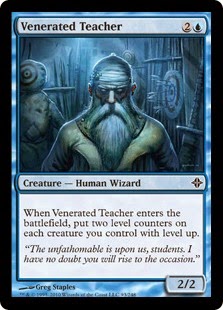
There is a teacher with the right idea.
Lastly, let's talk about "grinding." Anyone who has played WoW or any other MMORPG fully understands the tedium and necessity of grinding. It means standing in a field killing spiders or rabbits for four hours as you watch your experience bar slowly increase, and I don't see why there is no reason it shouldn't be allowed in the classroom. After all, grinding in a classroom setting is basically doing extra math problems or working on some tedious assignment to get a little extra credit. Obviously the "Grind Assignments" would be worth less experience points than regular assignments, but if a student accomplishes enough of them, they will slowly work their way up to the next level. It will also help reinforce the lessons that have already been learned. The essence of grinding is to take on a challenge you know you can easily beat and then repeat that over and over again. Why can't a student grab a basics skills sheet and do that for a small amount of experience points? A teacher can add more advanced skill sheets to the "Grind Pile" with older ones being worth less and less XP as the school year goes on and with newer ones becoming worth more. These would not be assignments, just extra tasks students could accomplish to keep their experience meter moving.

I know there will be many people who might be skeptical of this new idea, just as I realize it will work better for certain classes than others, such as Math and Language. Even though it might be harder to implement in English or Social Studies classes, that does not mean it would be impossible. These are only some of the ideas that are out there. A truly creative and dedicated teacher could easily come up with more, and adapt this idea to their learning environment. The real essence is the experience point system, but you can expand on that anyway you want. What about a loot system, where you get pens and pencils, or even hats and t-shirts. What about a friendly PvP or Arena system? What about a raid system where students collaborate and share XP to take on larger tasks? The possibilities are endless, and best of all, it is a learning system based upon a system we already know works to reach students. It is a system they instinctively understand. So instead of decrying the evils of the gaming industry, maybe its time we took a page from their books to patch some of the bugs in an ailing school system.


April 7, 2015

It's All Geek to Me

"Meh."

Three letters that express so much indifference, laziness, mild disappointment, and a general malaise to one's own existence, but there is also much more to that small interjection. It proves a point that language is not static. It morphs (like a verbal giant mechazoid,) with each new generation, each new year, and even with each new Netflix original.

In case you are unaware, Meh is a term that was coined by The Simpsons all the way back in 1994, when a librarian used it to react to the fact that voting records weren't classified in Springfield. Since then it has entered our vernacular as a dictionary-definable word. That was not The Simpsons' only contribution to English language, Cromulent and Craptacular both entered our collective vocabulary after being featured on the cultural juggernaut of a show, as well.

Language is an integral part of the human experience. Even those without the ability to speak or hear still engage in the use of language through other means. As such, the way we speak inherently affects the way we see and talk about the world around us, but that is not a one way street. The way we see the world and our interactions with it also affects the way we speak and talk about things. Additionally, our cultural experiences and understandings also influence our word choices, speech patterns, and other linguistic idiosyncrasies. This is nothing new either, our language (regardless of what language you speak) has been changing and evolving ever since our great x 10,000 grandfather grunted about someone not picking up after themselves.

I mean who leaves their dirty loincloth just lying around on the cave floor. "What were you raised in a barn?" (Which of course would mean that not only had you managed to move beyond the hunter-gather phase of civilization, but you had developed complex ideas of animal husbandry, crop rotation, feed storage, and construction techniques utilizing lumber.)

Realistically, cavemen would not have used the phrase What were you raised in a barn? I am sure they had other culturally relevant phrases to use when insulting their off-spring about their untidiness. I have no idea what those phrases were, but I am almost certain they had them, because humans shape our language with allusion and metaphor. We use our understanding of the world to influence the way we talk to one another, and I am not just talking about cliched lines that your grandfather might toss out.

For example: Toxic. The word traces its origins back to the Greek root-word toxon, which literally means a bow, the instrument you would use to shoot arrows from. That seems like an odd word to evolve into something that basically means poison, but not when you consider the story of Hercules and the Lernaean Hydra. The hydra's blood was poisonous, and after Hercules managed to kill the beast he dipped his arrows in its blood. He then used the poisoned arrows throughout the rest of his adventures. So in ancient Greek, saying something was toxic literally meant you were saying something was "from the bow of Hercules."

To them it was an allusion, a cultural idiom based around a story. The word then evolved into Latin and eventually into English to mean poisonous, with the original cultural reference lost to the ages, (unless you Google it.) More to the point, this is not the collective lexicon being influenced by just a person's direct experience with the world, but by a myth. Similarly calling someone Superman or Sherlock are two words not based on experience but on stories, mythologies in their own right, yet they are used commonly in everyday speech. Sticking with the comic book theme, Kryptonite, is literally a fictional rock that weakens Superman, but we use it in passing to mean someone's weakness, their Achilles' Heel.

The ancient Greek hero Achilles was invulnerable in every spot, except for his heel, the spot where his mother held him when she dipped him into the River Styx. Most people don't think of that story or need to explain it when they use the term Achilles Heel. People just understand what it means, because language is more than just sounds we make with our mouth holes. It's a social contract we all enter into, and it's not just about common words that represent ideas. Language is about nuance and even a little poetry. Yes, you can say, "I am not great at Math," or you can say "Math is my Kryptonite." It is more expressive, and it automatically gives the listener an intense and personal understanding of what you meant.

This means that culture (and especially nerd culture,) our stories, movies, comics, literature, etc, are all ways we absorb the world. They paint the picture that we hold up to compare to the people and places that surround us. We construct our world based upon all our influences, just like the Ancient Greeks. We do not have gods, we have superheroes. We do not have traditions, we have pop culture, but it all amounts to the same. It is a lens through which our lives and our language becomes filtered. Our shared stories give us a sort of cultural shorthand. We call someone a Newb or Noob if they suck, we say something has been Nerfed, if it was made softer or easier. Words like Frak and Khalessi enter into our vocabulary because, in some ways, they are more descriptive than saying F*ck or Barbarian Queen. Some will stick and some will fall off, proving to be nothing more than a fad, but they do enter into our thinking and our world views. We experience the world not only through the things we see and touch but through the stories that we tell, because language is so much more than pointing and grunting. It is so much more than mundane observations or utilitarian sound.

As Stephen Fry once said, "Language is my whore, my mistress, my wife, my pen-friend, my check-out girl. Language is a complimentary moist lemon-scented cleansing square or handy freshen-up wipette. Language is the breath of God, the dew on a fresh apple, it's the soft rain of dust that falls into a shaft of morning sun when you pull from an old bookshelf a forgotten volume of erotic diaries; language is the faint scent of urine on a pair of boxer shorts, it's a half-remembered childhood birthday party, a creak on the stair, a spluttering match held to a frosted pane, the warm wet, trusting touch of a leaking nappy, the hulk of a charred Panzer, the underside of a granite boulder, the first downy growth on the upper lip of a Mediterranean girl, cobwebs long since overrun by an old Wellington boot."

Language is also as Lisa Simpson once said, "Meh."

March 24, 2015

Not All Those Who Sonder Are Lost

Sonder n. The realization that each random passerby is living a life as vivid and complex as your own—populated with their own ambitions, friends, routines, worries and inherited craziness—an epic story that continues invisibly around you like an anthill sprawling deep underground, with elaborate passageways to thousands of other lives that you’ll never know existed, in which you might appear only once, as an extra sipping coffee in the background, as a blur of traffic passing on the highway, as a lighted window at dusk.

The above definition comes from the site: The Dictionary of Obscure Sorrows, and I think it might be my newest favorite site. Sonder is a realization, an epiphany that comes when you see that the guy who sells you coffee every morning has a picture of his family, or when that homeless man on the corner tells you that he graduated from Yale and served as an Army Ranger.  Now, with the impending possible discovery of parallel universes, thanks to the LHC, we may all have to acknowledge that we are not as truly remarkable and unique as we might sometimes like to believe. We tend to break the people in our lives (especially those on our peripheral) down to base stereotypes, unchanging and small boxes that allow us to view them in one light and then forget that they existed the moment they are gone. Sonder comes when those people surprise us and break out of the roles we assigned for them. Before that, they were just background characters, extras in the movie that is your life, your story.

It is interesting how stories, movies, plays, etc give us the language to talk  about this phenomenon. We are the main characters in our lives. Our story is about us, we see antagonists and challenges and plot twists wherever we look. We all see a cast of supporting characters, (our friends and family.) We understand that they are complex, but maybe not as complex of characters as we are. Then there are the extras, little more than set dressing to the happenings of our lives, but to them, we're the dressing. We become that guy standing on the subway, wearing the black jacket, or that girl walking down the street in uncomfortable shoes. More to the point that is all we will ever be in their stories, one-dimensional creatures. A few pixels in the background of a picture they took once. A voiceless body on the streets at night. All our problems, our thoughts, our wishes, our hopes, and fears, and loves, are nothing to them. Even celebrities are just faces on a screen. Yes, we may know their names and facts about their lives, but they still aren't the heroes of our stories.

This leads to a wrong-headed understanding that we are somehow important. It's what I am going to call ZSS, or Zombie Survivor Syndrome. Whenever people talk about the zombie apocalypse we always talk about what we would do to survive. We discuss how we would weather the crisis as part of a group of desperate survivors, but think about that. We never imagine it will be us who dies, who has the accident, who gets the heart attack. How could it be us? We are the hero? But statistically, you are more likely to wind up as Shambling Corpse #43 than as Rick or Carol, or any other survivor. Sonder is a state of understanding that we are not significant, at least not more so than anyone else around us. There is a saying that goes, "Everyone driving faster than me is a maniac, and everyone driving slower than me is a moron." Realizing that that is not true is sonder.

I have to admit, that I am broken, even just a little. Sonder is nothing new to me, though I never had a word to put to the sensation before. I have always been a bit too empathetic, at times it can prove a burden. Ever since I was a kid sitting in the back seat watching the passing cars I have wondered about the people in them. Where were they going? What did they do? Were they happy? Sad? Today I do it on a larger scale with co-workers and friends and the guy walking his dog on the street. Maybe that is just part of being a writer, a storyteller. I try to find the story in everyone I meet, but sometimes I also try not to. When you see everyone in the world as a potential diamond, than you realize that you are no different, no more special, than anyone else. The world doesn't owe me anything, at least not more or less than it owes that old woman at the supermarket. You see, there is a benefit to thinking you're special, it gives you drive and entitlement that helps you succeed. It helps to not think of all those zombie you are carelessly cutting through as special people: mothers, brothers, sisters, graphic designers, main characters in their own foregone life. We strive to be the Waldo, but sometimes we can't be. And sometimes we have to acknowledge that it's okay not to be.

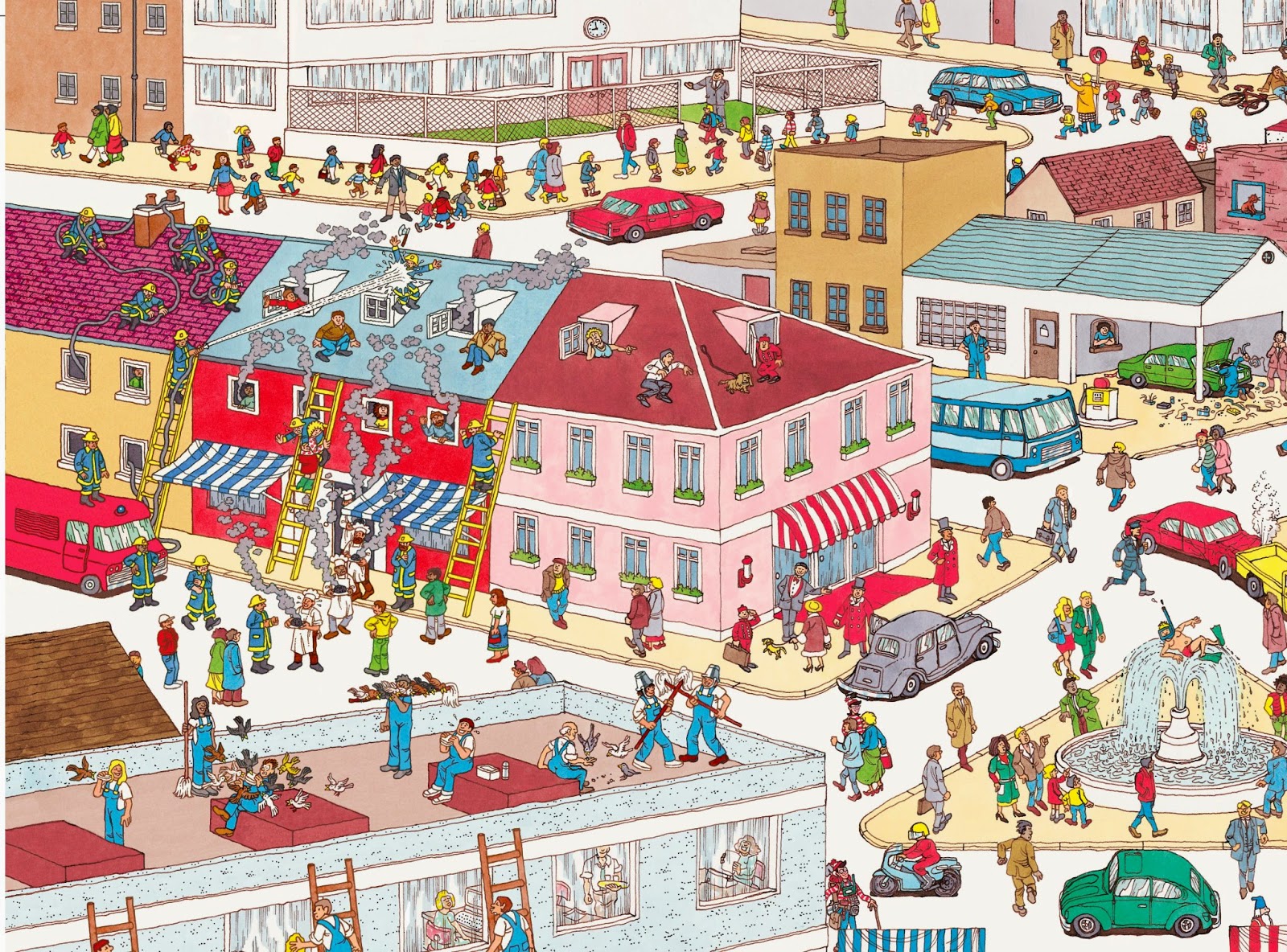
Where's Waldo is a perfect microcosm of sonder. The whole name implies that we need to find this one person, this special person. Look at the image to the left. Can you see Waldo? He is hidden amongst a multitude of people and crowds, but we ignore all those people. All we want to do is find this one man in a weirdly striped shirt. Hell, it's the name of the game. It's become a cultural expression. We look for the needle in the haystack while ignoring the hay, but have you ever stopped to look at the other people occupying Waldo's world? They are alive, they have their own problems and triumphs. There are fireman putting out a fire that was obviously started by three incompetent chefs. There is a car accident, a man in scuba gear in the fountain, kids crossing the street, a janitor being attacked by birds, and two more LARPing for their own amusement on a rooftop. All those people have lives, and maybe even animated spouses and children and pet parakeets waiting for them at home.

There is also a man at the bottom. He is on the right most ladder. He is trying to flirt with one of the secretary's working in the building, and it looks like she is responding. Maybe this is the culmination of his life, the thing he has been secretly hoping for, the love he has been waiting for? Or maybe he is an egotistically chauvinist asshole, but he is living the story as his own main character, completely oblivious to the idiot in the red and white hat and hiking gear. In fact, of all the people on this page, I would argue Waldo is one of the more boring ones. Sure he is seeing the world, but is he living in it? Whenever we see him he's alone, never engaged with another person or doing something wacky or something fun. He just stands there. So, yes, he is the main character of this book, but is that always the best thing? For my money I would rather be part of the couple who is standing in front of the building on fire. They are shoulder to shoulder watching the calamity unfurl as a chef tries to explain himself to a fireman, but they are together and there is something sweet about it, something that Waldo will never get to experience.

A state of sonder does not mean to imply that we are not unique, just not as unique as we sometimes think. You are not a diamond among the rough, just a diamond among many others. Still, a diamond is a diamond, and if more people thought like like this, if more people experienced sonder, than maybe the world would be a better place. After all, there is a benefit to not being Waldo, to being the guy standing above it all, looking down on the world and its all beauty and fountain scuba diving. When you stop thinking of yourself as something different you get to see how truly alike we all are. There will never be another you, but there will also never be another person like your mailman or that taxi driver that ran those two red lights or your baby niece in her crib. When you understand sonder, you understand how precious the world is, and how truly lucky we are to spend a few years passing through it.


March 17, 2015

Irish Superheroes

It is St. Patrick's Day and I plan on celebrating the same way I do every year, getting some nachos and tequila at On The Border. (I'll get a pint at an Irish pub on Cinco de Mayo.) It helps me to avoid people. I shouldn't be around people, but I am digressing... Let's talk superheroes, because what else are we going to talk about? (The fact that Antarctica is melting faster than we initially thought?) So let's talk about obscure superheroes (my favorite types) and on this most auspicious of holidays, we can all raise our margaritas and salute those poor Irish superheroes that get no respect.

Notable Irish-American Superheroes: Daredevil, Captain American, and one-half of Kyle Rayner (Green Lantern)

Banshee and Siryn (Marvel)
Perhaps two of the most well-known that will appear on this list. Sean Cassidy has been a member of the X-Men, as well as his daughter Theresa Maeve Rourke Cassidy. Don't get them confused, as Banshee is Sean's codename. (Chris Claremont wasn't aware that a "banshee" was a female Irish spirit when he named him.) They both have the distinction of being the only Irish superheroes to actually appear in a live action movie, with Banshee showing up in X-Men: First Class and Siryn making a cameo in X-Men 2: X-Men United. With that said, when Banshee was first created he was basically a walking Irish stereotype. He smoked a pipe, lived in a haunted castle, and hung out with leprechauns, (Aye, I'm not pulling your leg, laddie.) In later years, both himself and Siryn have become less two-dimensional with fully fledged backgrounds, plots, and villains. So, there is hope.


Shamrock (Marvel)
Staying with the stereotypes, you can't get much worse than Molly Fitzgerald. Shamrock has flame red hair, wears a literal shamrock on her chest, and her power is "Luck." Yes, she literally has the "Luck of the Irish" on her side. Born in Dunshaughlin, Ireland, she was the daughter of a militant member of the IRA. As Shamrock, she serves as a vessel for displaced poltergeists and souls that have died as innocent victims of war; these spirits manifest themselves for fractions of seconds to cause good luck for her and bad luck for those who oppose her. For the most part, she served as a throw-away character that Marvel created for a crossover event called Contest of Champions. In other words, Marvel writers basically said, "We need an Irish superhero?" and another replied "How about we call her Shamrock. She can be lucky?" and then the whole room cried out, "Brilliant!" and harrumphed a lot. In the modern Marvel timeline she has retired from superheroics and opened a bar in New York City.


Jack O'Lantern (DC)
Are you starting to sense a pattern here? Jack O'Lantern is the title held by several people in the DC universe, most of which have been Irish. The most notable are Daniel Cormac and Liam McHugh. Jack O'Lantern is a superhero who possess a literal magical lantern that was given to him by fairy folk. This mystical lantern gives him the power of flight, flame projection, teleportation, illusion casting, enhanced strength, and the ability to create fog. In the more modern iterations of this character, McHugh has internalized the power of the lantern, so he no longer needs to carry it around. He was also a former "Irish freedom fighter," who often quibbles with his British teammate, Knight, because.. you know... that's what Irish and English people do.

Hellstrike (DC/Wildstorm)
Nigel Keane was born in Belfast, and served in the British police constabulary before moving to London, where he fell in love with Anne, his partner while investigating the IRA. Their relationship lasts until an Irish terrorist/mercenary, kills her in front of him... etc... etc. Hellstrike is a gaseous sentient post-human entity that can fire explosive plasma bolts, build a protective plasma shield, and fly. Unfortunately he is also bound to a containment suit that prevents him from dispersing. At least as far as originality of powers goes, I give Hellstrike an "A" for effort, and he is a rather complicated character, even becoming a villain for a small while. Yet, he still falls along several stereotyped lines. I mean, it amazes me how many Irish superheroes have ties to the IRA. Can't one of them just be some guy that used to sell newspapers on a street corner, or something. Do they all have to be fighting for or against Irish freedom, (which hasn't really been a thing since the mid-90's.)


Hitman (DC)
Perhaps one of the most fleshed out and interesting characters you have never heard of, Thomas Monaghan lives in Gotham City's Irish neighborhood, "The Cauldron." A Gulf War veteran he is bitten by a Bloodlines parasite (which is best not discussed) and granted the abilities of x-ray vision and limited telepathy. He then uses his new abilities to become a contract killer of metahumans, (super-humans... "Wait, I finally get the name of this blog,") which are targets most assassins and mercenaries won't go after in the DC universe, for super-obvious reasons. Somewhat of an anti-hero he has helped the Justice League out on occasions, but he spends most of his time with Section 8, DC's answer to Marvel's Great Lakes Avengers. A team of pathetic and low-powered superheroes that usually end up doing more harm than good. Even Tommy's adventures tend to be a bit more tongue-in-cheek, like the time he showed up to a tryout for the Justice League, just to use his x-ray vision on Wonder Woman. Unfortunately, with DC's new slant on dark and gritty, it doesn't seem like Hitman will be making a reappearance in the New 52 anytime soon. Even if he does, he will probably be a former member of the IRA, if not wearing a shamrock on his lapel... you know because... Ireland.

Happy St. Patrick's Day.


March 10, 2015

Back to the Future

Spring is in the air.
I don't even know what the title of this blog means, and I don't care. It's too damn early. Also, if I nod off while typing this I hope you ex... Apples!... What was I saying? Oh, yeah Daylight Savings began this past Sunday, and I, like most Americans, am having a very hard time adjusting. I am exhausted, confused, irritable, and magenta. This all leads me to wonder, "Why the hell do we do this, again?" Seriously, why hasn't anyone put a stop to this? Our government keeps looking for non-partisan issues that are favorable among the American populace. I think we found one. I can't imagine anyone protesting: bankers, students, farmers, Canadians, eggs, meat, dairy, friction, gravity, the letter C... Hornswoggle!...

Sorry. I'm back. Actually, there might be one type of people that in the United States that aren't drastically affected by Daylight Savings Time: Arizonans, but also American Congressmen. I did some checking on the Congressional schedule, and I was shocked (shocked I say) to discover that the House of Representatives is not in session the week after Daylight Savings, because they are lazy, unlike their hardworking counterparts in the Senate. No time change is going to stop a Senator from reporting to duty on Monday, bright and early, at the crack of... 2:00 pm.... I didn't nod off just then. That is actually the time they started sessions on Monday, March 9, 2015. Also, they were so proud of themselves for working half-day on Monday that they gave themselves the rest of the week off. So, I guess we shouldn't look to our Legislative Branch to be making changes to this antiquated law anytime soon. For now, we are all going to have endure the hour of jet lag, (as if the country took a collective red-eye flight from O'Hare to JFK,) but how did this all start, you might be asking? Or not, I could just be hearing voices in my exhausted state.

Actually, the practice started back in Germany during the First World War to conserve coal for the war effort. So like most things in life if you are looking to blame someone, you can blame the Ger... Kaiser Wilhelm!... I was having the weirdest dream. Anyway, the practice was used on and off after the end of the Great War, but it didn't really become adopted by North America until the Second World War, because the Germans had so much fun during the first one they all got together and decided to do it all over again, like that kid who spends all day on the water slide. "Get off the water slide, Jimmy! Other people want to have a turn!"

What? I was somewhere else for a second. Regardless, there are only about 70 countries left in the world that use Daylight Savings, and we are lucky enough to live in one of them, but don't worry we're not alone, as most of Europe, parts of South America, and (the civilized parts) of Australia still use the damn system. So, you may have to wake up an hour early, but it could be worse. You could have to wake up an hour early in France. You'd still be tired, but you'd also be in France, and coffee would cost you twelve dollars and you would only be able to get a baguette for breakfast. So does anyone benefit from this wild idea of time-space witchcraft?

Don't mess with blue countries this week. They might be a little cranky.
Image courtes... Wikipedia!
Daylight Savings used to have a financial benefit. More sunlight meant less time with light bulbs lit and lower electricity bills, but now it just translates into more time running the air conditioner and staying in doors playing Xbox and Playstation and Tiddlywinks, and dinosaur, and pen top, and print toner, and fjgjdyyyyyy... Jim Caviezel!... I hit my head on the keyboard that time... Anyway, as I was saying, there is no longer a discernible financial benefit from the practice, and perhaps the cherry on that cake is that farmers hate it. So for anyone out there who thinks this is for the benefit of agriculture, you can back that Tonka truck up. Those poor bastards have to get up in the morning to feed the chickens whether its dark or light out, and I won't even mention the dangers of sending schoolchildren to school in the newly darkened morning hours, or the fact that car accidents rise 17% the week after Daylight Savings. However, I have found the one group that the time change does benefit, golfers.

Yes, the extra hour of sunlight after the work day benefits golfers, which means the rest of us have to suffer under their white gloved thumb, like a ball being run through that cleaning machine they have on the side of the fairways. You know what I'm talking about. So my real question is, what do golfers do in Arizona, where they do not use Daylight Savings time? (I guess the answer would be sweat, a lot,) Or on any one of the multitude of Native American Reservations where they also don't use the system? Because despite what some people think, this is not a universal law. States, and even some towns, have opted out of Daylight Savings.

Then again, maybe I am being too harsh in my manic sleep deprived state. I mean forget the fact that 63% of Americans don't see the purpose to setting our clocks ahead in the Spring, or that this practice absolutely wreaks havoc with international business, (because when you're in New York its hard enough trying to figure out the time in Beijing without also remembering that you need to add or subtract an hour depending on the season,) and maybe we should all just be a little more like Congress. So I propose, we make the day after Daylight Savings a national holiday where we all start work at 2:00 pm, then go golfing afterward. Wouldn't life be just sw.......................


February 24, 2015

Tweeting Aliens

Why do you people always call during Bleet-blorp?
So I was away last week, and during my time off I found myself revisiting Space Chronicles by Neil deGrasse Tyson. This was my second read through and I tore through it in about a day and a half. Partly I used the book as a resource for a writing project I have been working on, but it also could have been the trip to the Kennedy Space Center in Florida that helped to re-inspired my return to the words and passions of Dr. Tyson. Either way, I have find myself in a certain mood of cosmic musing.

So imagine my interest when I returned to the real world and started reading about how SETI (Search for Extraterrestrial Intelligence) scientists debated the merits of sending active messages into space in order to look for intelligent life during the annual meeting of the American Association for the Advancement of Science. This is called Active SETI or METI (Messaging to Extraterrestrial Intelligence,) a name I find ironic, because I am on Twitter and I sometimes wonder if most of us are even messaging any intelligent life here on Earth.

There have been a few attempts at intergalactic emails in the past. My favorite attempt came in 2008, when NASA beamed the Beatles song, Across the Universe to Polaris. Though in all fairness this wasn't considered an actual attempt to make contact with an alien race, more of a publicity stunt cooked up NASA and a Beatles historian. By all accounts Polaris (our North Star) most likely does not harbor any worlds that would be capable of supporting life. However, there have been other more serious attempts at sending isolated messages to nearby star systems, such as A Message from Earth.

This message was a high powered digital radio transmission aimed at Gliese 581, specifically Gliese 581c, which is a possibly habitable planet with a warm and temperature climate that is a good candidate for housing life. The message was sent in 2008 and contained 501 messages that were selected through a contest on the social media site, Bebo. These messages will reach the planet in 2029, and then I guess we wait and see if we get a response or just some version of an answering machine message. (Maybe they are screening us.) Similarly, in 2013, the somewhat controversial Lone Signal project began, founded by two businessmen.

The Lone Signal charges the public money so that they can send messages, 144-characters in length, to the red dwarf star Gliese 526 which has its own confirmed planetary system. Unlike A Message from Earth, this is not a one time time transmission. In fact, the Lone Signal project wants to earn enough money to build a network of radio dishes to actively send messages to a variety of candidate solar systems within our galactic neighborhood... and who better to be our first ambassadors to these distant neighbors than any jerk on the Internet that is willing to pay twenty-five cents to send a penis joke to the real-life equivalent of the Klingon Empire.

This brings us back to the debate among the SETI scientists, which was held at the AAAS 2015 Conference this past week. If we are going to start sending active messages of greeting out into the universe, we will need to be prepared for the consequence of getting an answer back in return. For most of its life, the SETI Institute has only listened to the heavens, like some creepy dude in the 90's that cruised around with a baby monitor to listen to people talk on their cordless telephones.

SETI themselves lays out some of the dangers on their website. Until now, SETI researchers have not been very interested in broadcasting... To begin with, we are a technologically young civilization... there are surely societies that have possessed the ability to send high-powered signals for tens of thousands, if not millions, of years... We are the new kids on the technology block, it may behoove us to listen first. Some have also expressed concern that broadcasting might be dangerous, literally calling attention to our existence. Even Stephen Hawking believes that any alien visitors would basically treat us the way Europeans treated Native Americans, (which if you need a history refresher didn't turn out so great for Native Americans.)

Hit me up on Twitter @IWantToBurstOutOfYourChest
Yet, is that just a pessimistic view or is there truth to it? After all, there are plenty of reasons why making a friend request across the galaxy could be beneficial, (and not just for having someone to share our food pics with, either.) No matter who you are, you have to admit that Earth is far from perfect. We have a lot of problems, and some friendly visitors from beyond our solar system could bring some solutions, such as cleaner energy, faster computer processors, maybe even a way to reverse the effects of global warming, to say nothing of the possibilities of interstellar travel. Heck, even if we just got back a message saying, "Hey, how are you? We like your profile, and we'd be very interested in meeting up sometime for a drink," (Which, is basically every message I send girls through my dating profile,) our society would still be irrevocably altered.

If humans were forced to live with concrete proof of the existence of intelligent extraterrestrials, even if they remain as trapped on their world as we do on ours, it would mean that we would have to face some pretty tough questions. We would know that we were no longer alone, no longer special. What does that mean for religion? for governments? for science? for that guy who stands on my street corner everyday with the tinfoil hat? Would there be widespread panic, or something better. Would we start to look at each other differently when we realize that our differences, skin, eyes, ethnic upbringing, are not so "alien" after all, when compared to the face of real ETs? I don't have the answers to any of those questions, and I don't know if anyone will until the time we are forced to answer them.

All I do know is that real scientists this past week debated the merit of announcing our presence to the galaxy, and the possibility of alien invasion, (and whatever else happens, that's pretty cool.) In all fairness, we have been broadcasting our presence for a while now with the slew of radio, TV, and, most recently, Internet broadcasts that have been steadily expanding around our place in the galaxy like a sphere of Nick at Nite reruns, featuring I Love Lucy and (what is sure to be very confusing) Star Trek, but we have never made a large scale and sustained effort to actively send targeted messages to star systems which are candidates for Earth-like worlds. More to the point, an Active SETI search has people nervous enough to voice their opinion about it. After all, there is a difference between waiting with your hand up to be acknowledged and standing up on your desk and screaming at the teacher.

As for my own personal opinion, I find myself being against the idea, and not so much because of the threat of alien invasion, but because I don't want humanity announcing its presence prematurely. We are a young race and we do have a lot to figure out before we start introducing ourselves to our neighbors. Things like the Golden Disks are all well and good as symbolic gestures, but we need to get our house in order first. We need to earn our place among the stars, and not have it handed to us as long as we put on a good face and ask very nicely. As great as it would be to have an influx of alien technology, I don't know if we are ready for it. I think we have to face our present challenges ourselves, and live the lessons that come along with achieving a space-faring society, even if that means we risk our own annihilation. If there is a galactic society out there, whether it be a Federation or an Empire, let us meet its members as equals, not as a charity case or as an easily conquered world.

I'm not alone in believing this either. None other than Dr. Frank Drake (of the Drake Equation fame) listened to the conference and said, I think it’s a waste of time at the present. It's like somebody trying to send an e-mail to somebody whose e-mail address they don’t know, and whose name they don’t know. (We would basically be sending galactic spam,) but even if the call were to be answered and we were to invite our new friends over for a play date, it is worth noting that we really shouldn't know what to expect. I will give the last word of this to the man whose words should carry the most weight, Neil deGrasse Tyson.  

We actually have some evidence of what happens when a high technological culture meets a low-technology culture. Our species bears this out multiple times in the history books, and it doesn’t bode well for the culture that has less technology. But I would say to fear an alien for that reason is more a reflection of how we know we treat each other than it is on how we could ever possibly suspect an alien to treat us. And so why should we be the measure of hatred in the universe?
 
(PS: It is worth noting that the 2015 AAAS Conference also held several extremely important symposiums on Ebola and controlling infectious diseases, climate change, scientific education, global human resources, and much more serious topics than sending out our Instagram photos to Alpha Centuri. [Un]surprisingly, though, it was the Active SETI portion of the conference that the news media actually decided to report on... I just wanted to leave you with that thought.)


February 10, 2015

The Avenging Spider-Man

It's official. Spider-Man has been confirmed as being added to the Marvel Cinematic Universe in an unprecedented agreement set between Marvel and Sony. Basically Sony will retain distributive, financial, and creative control, but Marvel will get a piece of the pie. Kevin Feige, the man behind the MCU, is also set to co-produce the next independent Spider-Man movie. This is all exciting news and I think a positive step for both production companies, but it still leaves us with some questions that are worth contemplating.

First and foremost, who will be Spider-Man. Will it be Andrew Garfield, will it be a new actor, will it be me? (Seriously, I'm waiting on that phone call.) Smart money seems to think that it won't be Garfield and that this new agreement marks a new Spider-Man with a new direction. Yet, if that is the case, is the viewing public really ready for a third attempt at Spider-Man? Though, this new Web-Head would have the advantage of being able to hang with Daredevil and get an internship from Tony Stark, it still sets up the question, "Are we are risking Spider-Man whip-lash?" After all, do we want to see another Green Goblin storyline or another Lizard or Electro or Venom... Scratch that I would like to see another attempt made at Venom... But the point remains that the new MCU Spider-Man is not going to be some hit and run hero that gets a five minute cameo in the Avengers and we never see again. He will have at least one more stand-alone movie. So how do we keep him fresh?

The most obvious and exciting prospect is a boy named Miles Morales. For anyone not in the know, Miles is Spider-man in Marvel's Ultimate Universe after Peter Parker dies. Now I'm not suggesting that we kill of Garfield onscreen to be replaced by Donald Glover, (but I'm also not not suggesting that either.) His origins can be changed, but Marvel, Sony, and comics in general have found themselves struggling with ideas of diversity in characters. This is a great opportunity to bring that issue to the forefront. Yes, Black Panther is coming, but T'Challa is an African prince from a distant land. Miles Morales is a kid from a poor neighborhood of New York City. Which one do you think is more representative of the American experience? And choosing the racially diverse Morales over the very white Parker would go a long way to cementing people's faith in Marvel and its properties. Yes, there would be people who would raise an outcry, but Peter Parker has had five movies, two good, one okay, and two bad. Maybe its time to give someone else a turn in the batters box.

Unfortunately, as much as I think this is the direction that Marvel should go, I have doubts it will happen. Peter Parker has too much name recognition. So what do we do with him in his next movie? Most obviously, drop the damn Origin story, especially if it is a new actor. If I had a nickle every time I saw Uncle Ben get shot, I could buy a modestly priced Tesla car. We all know where and when Spider-Man came from. There is no good reason to rehash it again. Also put "With great power come great responsibility" back in to the movie. I know Sam Rami used to to death, but it's a personal pet peeve of mine that it got taken out in the Garfield version... So really I'm just asking that you make me, alone, happy. Is that too much to ask? (Waiting on that call.)

Next, do something new and exciting with the next Spider-Man movie. If its going to be set in the MCU, than really go with it. If we stick with Garfield, I would be interested in seeing a third movie that is about him coping with becoming an Avenger or dealing with whatever just happened in Civil War. Or tell a movie that is half flashbacks to Spider-Man's involvement in the Chitauri Invasion from the first Avengers movie. We know Spider-Man wasn't directly involved in the main battle, but what if he spent the invasion saving people or battling an escaped villain on the peripheral for the invasion. A storyline like that would help cement Spider-Man into the MCU, and may even allow the chance to bring Garfield's already established storyline into the larger universe.

If we don't stick with Garfield, I would still like to see a movie set in the larger universe. So maybe we don't want to use Green Goblin, but what if Norman Osborn does something that tricks the Hulk into rampaging through New York City. Spider-Man would have to stop him, which is an incredibly daunting task for a superhero that is still basically a teenager. It would also allow Marvel to get the Hulk into another movie (something they have wanted to do for years.) This would be a perfect way to put a fresh spin on a Spider-Man movie without dipping into what is left of the lower-level Spider-Man cadre of villains. (If we are forced to sit through a movie version of Shocker or Vulture, I don't know if I could take it.)

Lastly, there also remains the question of how will Spider-Man first appear in the MCU. It has been confirmed that we will get a cameo or a glimpse of him in a Marvel property before we see him in his own stand alone movie. Yet, that could mean almost anything. Does that mean he will be the stinger at the end of Avengers: Age of Ultron? Does it mean he will take the place of Black Panther as a main character in Captain America: Civil War, (which would be a blow for Panther, but in all fairness it was his role to begin with, and it would be a really good way to put him front and center in the MCU,) or will it be in something else or in some other way? I do believe that the manner and way in which he is introduced will set the tone for his involvement (heavy or light) in the MCU, but I suppose only time will tell.

It seems almost surreal this is actually happening, especially considering Joss Whedon was almost crucified by lawyers when he tried to even hide a hint of the Oscorp building in the New York skyline in Avengers. However, this is very good and it is coming at the right time for both companies. Sony is in desperate need. The Amazing Spider-Man 2 was a flop and put them back in the same place they were after Rami's Spider-Man 3. The fact that they are willing to share will put a lot of fan faith back in the studio. 

As for Marvel, they are going stronger than ever, but we can see the horizon and there are some concerns. With contracts for Downey, Evans, Hemsworth, and their other big name stars set to expire the MCU will soon be losing their tent-pole heroes. So how does the Marvel Universe exist after Captain America, Iron Man, and Thor disappear? The answer will be a mixture of carrying on those mantles in other ways. I am almost positive there will be a new Captain America after Evans. Iron Man may hang around as the old man of the universe, but it won't be the same. This is where the potential for Spider-Man is so impressive. He has always been the big Marvel character, but has faded from glory over the past decade as the company has focused more on their own properties and heroes and shined the light away from him, due to the Sony conflict. Yet, in many ways he is still the main-man. He still has the kind of star power that Marvel is going to need to keep them moving beyond that Infinity War threshold. Introducing him now could represent the passing of the torch from the Big 3 back to our friendly neighborhood Spider-Man and the continuation of this shared universe they have created.